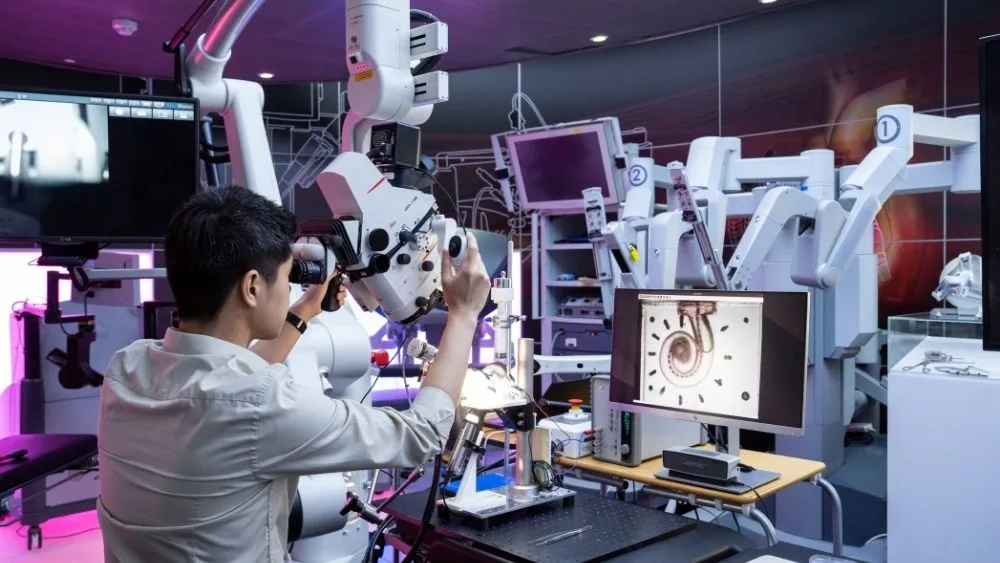
Marking a new approach to innovation in medical robotics, the new centre will bring advances from a leading surgical robotics research group to patients more quickly. Smith+Nephew, the global medical technology company, has partnered with Imperial College London. The organisations have launched a five-year partnership focused on surgical robotics innovation.
The collaboration will support breakthrough research for robotic surgery used in musculoskeletal conditions. It will also connect academic research with practical medical technology development. The partnership brings together a globally recognised academic laboratory and Smith+Nephew engineers. Together, they will work to accelerate advances in surgical robotics.
Research will be focused on areas such as advanced sensing technologies and computer vision. Such advances could lay the foundation for new approaches in robotic surgery. The partnership also will speed the translation of academic discoveries to the clinic. Teams will develop technologies to enable minimally invasive robotic surgery.
The solutions will also aim to make robotic procedures more intuitive and easier to use. As a result, the technology could become accessible beyond specialist medical centres. This approach could support better surgical outcomes for patients. It may also improve the overall experience for surgeons during complex procedures. The centre represents an important development for both organisations. It marks the first time Smith+Nephew has established this type of centre within a university.
It also represents Imperial College London’s first industry centre focused on medical technology. Therefore, the partnership creates a new model for collaboration between academia and industry.
New Model for Medical Technology Innovation
Traditional medical technology innovation often follows established development routes. Companies may develop technologies internally or license discoveries from universities. However, Smith+Nephew and Imperial College London are taking a different approach. Experts from Smith+Nephew will work directly alongside university researchers.
And the teams will closely collaborate to co-create new solutions. Smith+Nephew will also leverage its global scale to help accelerate technology adoption. This could help accelerate the translation of cutting edge techniques to the clinic. It could also help bridge the distance between academic research and operating rooms. The center will be headed by Professor Ferdinando Rodriguez y Baena. He is at the Mechanical Engineering Department, Imperial.
He also serves as co-director of the Hamlyn Centre. His research group focuses on robotics for orthopaedic surgery. At full capacity, the centre will support a senior postdoctoral researcher. It will also support up to seven fully funded PhD studentships.
The programme will recruit researchers progressively during the five-year partnership. Researchers will work alongside Smith+Nephew engineers and clinicians. The teams will share the same working environment. This setup will encourage closer communication and faster development.
The new university technology centre will operate within Imperial’s Hamlyn Centre. The centre forms part of the Institute of Global Health Innovation. The Hamlyn Centre also plays an important role in robotic surgery research. Its work covers technologies designed to address complex healthcare challenges.
Research Focus on Advanced Robotic Surgery
The research programme will focus on making robotic surgery less invasive. It will also explore ways to expand access beyond specialist centres. One research area involves markerless registration and tracking. Current systems often use pins and rigid markers attached to bone.
The new approach could remove the need for those physical markers. Consequently, patients could require fewer incisions during procedures. They could also need less hardware during surgery. At the same time, the technology could provide greater consistency for surgeons.
Another research area will focus on computer vision. This technology can interpret a patient’s anatomy during a procedure. The system could then adapt to anatomical changes in real time. Such capabilities may improve the precision and usability of robotic surgery.
Vasant Padmanabhan, President of Research & Development, ENT and Emerging Markets at Smith+Nephew, said, “In Smith+Nephew’s 170th year, we are proud to partner with a university that embodies a similar heritage in UK medical innovation. By embedding industry experts within one of the world’s leading engineering schools, this centre has the potential to move research into operating theatres at pace, transforming patient outcomes and enhancing the surgical experience.”
Professor Ferdinando Rodriguez y Baena from Imperial College London said: “Translational research on health devices has historically had two main routes to patients: licensing or spinout companies. This centre establishes a third: academic engineers working hand-in-hand to help develop products with a major industry partner. There is no doubt that the innovations discovered within this centre will hold major impact for the medical technology industry as a whole and its patients.”
Professor Mary Ryan, Vice-Provost (Research and Enterprise) at Imperial College London, said, “Working directly with Smith+Nephew, will allow us to bring advanced innovations rapidly to the clinic, drawing on Imperial’s world-leading academic expertise and the company’s resources and sectoral knowledge. We look forward to further expanding our large-scale partnerships with industry in this space and bringing innovations in medical technology to patients more quickly.”
The partnership highlights the growing role of surgical robotics in modern healthcare. It also demonstrates the value of collaboration between technology companies and universities. Through the new centre, Smith+Nephew and Imperial aim to advance research more efficiently. The partnership will combine engineering expertise, clinical knowledge and industry resources.
Ultimately, the programme seeks to bring innovative robotic surgery technologies closer to patients. It will also support the development of less invasive and more accessible surgical procedures.
Explore Health Tech Insiders for the latest medical innovations and reliable strategic insights driving the future of technology-driven healthcare transformation.
News Source: GlobeNewswire.com