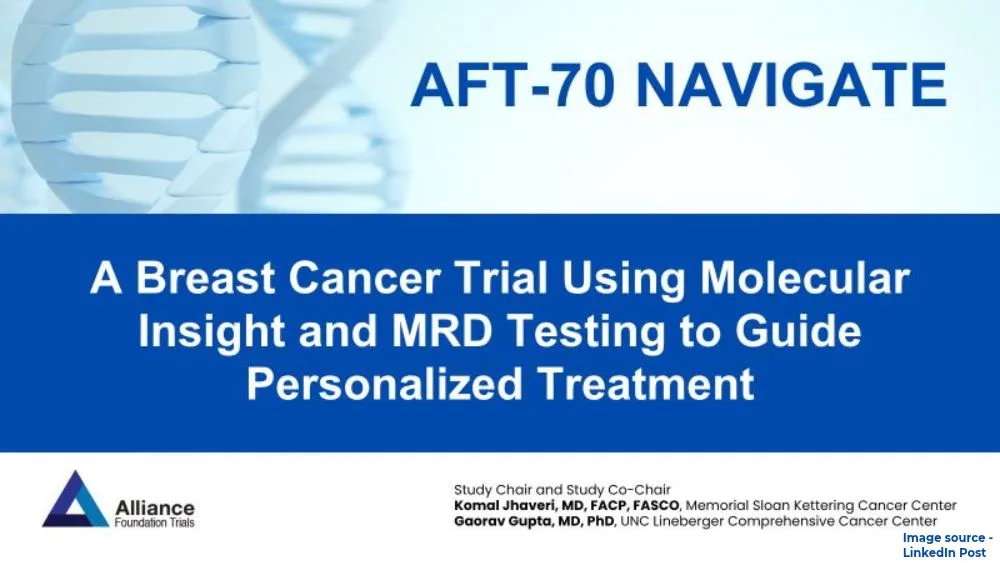
The trials of Alliance Foundation and Natera have started the international Phase III breast cancer trial named AFT-70 NAVIGATE.
It assesses a treatment approach which is guided by the results of MRD. This trial includes people suffering from intermediate and high-risk ER-positive/HER2-negative early breast cancer. Alliance Foundation Trials sponsor and manage the trial. Natera and Genentech are collaborating and co-funding the trial. It will be researching a more selective treatment approach to CDK4/6 inhibitors. AFT-70 NAVIGATE combines giredestrant with longitudinal Signatera Genome MRD assessment. In this way, it tries to select those people who need treatment escalation.
Giredestrant is the backbone of the endocrine therapy of the investigational treatment approach. The Phase III lidERA results proved its use in this trial.
The lidERA trial demonstrated better invasive disease-free survival for giredestrant. It compared it with standard endocrine monotherapy. The reason for the use of Signatera in the trial is its clinical evidence in early breast cancer. Its genome technology achieves analytical sensitivity below 1 ppm.
AFT-70 NAVIGATE Targets More Precise Treatment
Alliance Foundation Trials anticipates enrolling over 2,000 participants in the trial. The trial will be conducted at an estimated 200 sites in the United States and worldwide. Inclusion criteria will include having stage II-III ER-positive/HER2-negative breast cancer that is eligible for endocrine therapy.
Those without detectable MRD will receive one of two strategies. Doctors will give the control group endocrine therapy with upfront CDK4/6 inhibition. In the experimental arm, they will first receive giredestrant. Doctors will start CDK4/6 inhibitor therapy once Signatera detects MRD. The primary objective is to determine non-inferiority for four-year distant recurrence-free survival.
“This collaboration brings together leading expertise in breast cancer research, clinical care, and molecular testing to address an important question for patients: How can we make treatment more precise while avoiding unnecessary toxicity?” said Evanthia Galanis, M.D., D.Sc., president of Alliance Foundation Trials, LLC. “By using MRD technology to guide treatment decisions, this trial has the potential to transform care for eligible breast cancer patients and individualize treatment intensity.”
“We know that patients with ER-positive, HER2-negative breast cancer do not all face the same risk of recurrence, yet adjuvant treatment decisions are still largely based on clinical and pathological features measured at diagnosis,” said Komal Jhaveri, M.D., FACP, FASCO study chair, breast medical oncologist and early drug development specialist at Memorial Sloan Kettering Cancer Center. “The AFT-70 NAVIGATE trial combines two important advances: an endocrine therapy backbone with giredestrant and longitudinal MRD testing with Signatera that can provide a dynamic measure of recurrence risk. The trial will determine whether MRD-guided monitoring can distinguish patients most likely to benefit from adding a CDK4/6 inhibitor from those in whom it can be safely omitted. It’s an important step forward using biology—not just baseline risk—to guide adjuvant therapy.”
“More treatment is not always better treatment,” said Gaorav Gupta, M.D., Ph.D., study co-chair, breast radiation oncologist, and co-leader of the Breast Cancer Research Program at UNC Lineberger Comprehensive Cancer Center. “CDK4/6 inhibitors can be an important part of care for some patients, but they can also add side effects, monitoring, and treatment burden. If highly sensitive blood-based MRD testing can identify patients who can safely defer additional therapy, we may be able to spare many patients from the burdens of more treatment while maintaining excellent cancer control. That is the promise we hope to explore through this study.”
“Natera and AFT have a longstanding partnership and shared commitment to cutting-edge trials across many cancer types,” said Minetta Liu, M.D., chief medical officer, oncology and early cancer detection, Natera. “AFT-70 NAVIGATE creates enormous potential to enhance treatment options for patients with intermediate and high-risk, hormone receptor positive breast cancer.”
Explore Health Tech Insiders for the latest medical innovations and reliable strategic insights driving the future of technology-driven healthcare transformation.
News Source: Businesswire.com