

Komodo Health® and National Committee for Quality Assurance (NCQA) Announce Multi-Year Strategic Partnership The partnership will focus on enhancing the measurement of healthcare quality with real-world data and healthcare-native AI. The partnership will improve the development, validation and ongoing refinement of healthcare quality measures. It will also enable NCQA to be more responsive to changes throughout the contemporary health care delivery system.
NCQA has been driving health care quality improvement through transparency and accountability for more than 35 years. Its Healthcare Effectiveness Data and Information Set (HEDIS®) continues to be a common tool used for performance improvement. Commercial, Medicaid, and Medicare health plans use HEDIS. It also serves other organizations in the healthcare industry. As health care delivery continues to evolve, NCQA is updating its HEDIS portfolio. The group is looking for clearer and more actionable signals. These signals can help improve care, accountability and value in health care systems. But this goal requires more than developing appropriate measures.
Healthcare organizations also need efficient methods to develop, validate, and update those measures. These methods must keep pace with clinical evidence and real-world care. Traditionally, teams needed to combine fragmented datasets from several sources. This process often created lengthy development and testing cycles. Now, the collaboration gives NCQA access to Komodo Health’s Healthcare Map®. The platform provides a broad view of more than 330 million de-identified patient journeys.
Real-World Data Supports Faster Quality Measurement
The Healthcare Map allows researchers to examine care across different insurance types. It also supports analysis across care settings and patient populations. Therefore, NCQA can use one longitudinal data source to study healthcare delivery. This approach can reduce the complexity associated with fragmented healthcare datasets. Komodo Health will also provide access to Marmot™. Marmot is Komodo’s healthcare-native AI analytics platform. The platform uses the Healthcare Map to support complex healthcare research. It enables NCQA researchers to explore healthcare questions more efficiently.
Marmot also supports transparent and reproducible analyzes. The analyzes are still grounded in real-world evidence. Together these capabilities can help NCQA evaluate potential measures more quickly. They can also increase efficiency across the quality measurement process. Importantly, the collaboration preserves scientific rigor at the heart of the work. It also maintains the transparency needed to effectively evaluate quality. That helps NCQA continue to create HEDIS measures that reflect the healthcare of today. This way, the organization can also respond to changes in clinical practice.
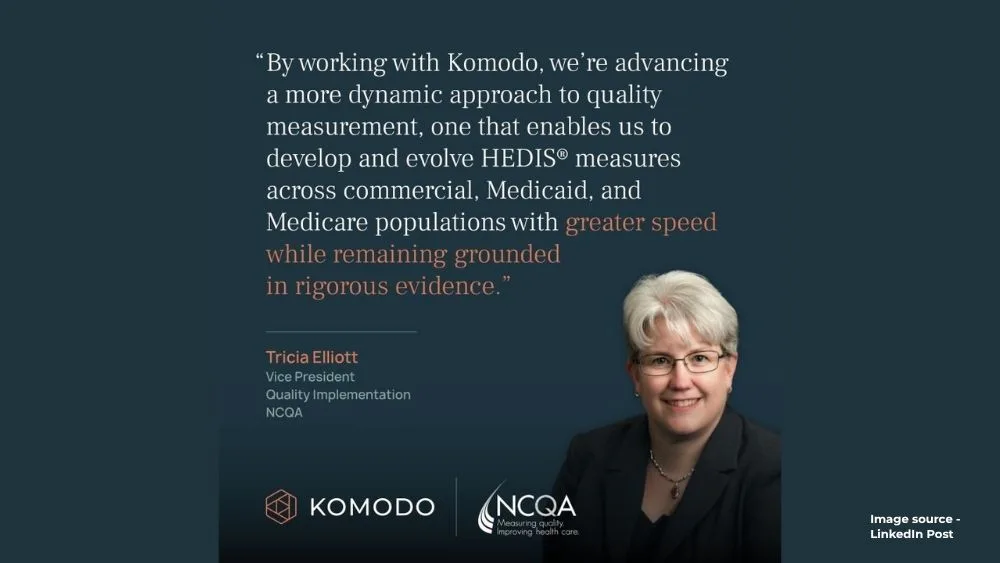
“The future of quality measurement depends on our ability to ensure measures remain meaningful, actionable, and aligned with how care is delivered,” said Tricia Elliott, Vice President, Quality Implementation, NCQA. “By working with Komodo, we’re advancing a more dynamic approach to quality measurement, one that enables us to develop and evolve HEDIS measures across commercial, Medicaid, and Medicare populations with greater speed while remaining grounded in rigorous evidence.”
The partnership has already contributed to a new HEDIS measure. The measure is called Follow-Up After Positive Colorectal Cancer Non-Invasive Screening Test (COF-E).
HEDIS Measure Development Gains Speed
The COF-E measure examines follow-up care after a positive screening result. Specifically, it evaluates whether patients receive a timely colonoscopy. The measure supports earlier detection and treatment of colorectal cancer. NCQA plans to implement the measure during Measurement Year 2027. Historically, quantitative testing for a new HEDIS measure took two to three months. However, NCQA tested the COF-E measure in about one month using Komodo’s capabilities.
Marmot also enables transparent and reproducible analysis. The analyzes are still based on real-world data. Collectively, these capabilities can help the NCQA evaluate potential measures more quickly. They can also streamline the process of quality measurement. Critically, the partnership places scientific rigor at the core of the work. It also preserves the transparency necessary for good quality measurement. That helps NCQA continue to develop HEDIS measures that reflect health care today. In this way, the organization can also adapt to changes in clinical practice.
The collaboration highlights the growing role of real-world evidence in healthcare research. It also demonstrates how healthcare-native AI can support complex analytical work.
“This effort underscores the power of real-world evidence and trusted, healthcare-native AI that enables healthcare organizations to better understand what’s happening across patient populations,” said Miles Ennis, President of Komodo Health. “We’re proud to support NCQA as they work to ensure quality measurement evolves alongside advances in healthcare delivery and continues to drive better outcomes for patients.”
The collaboration is creating a more dynamic approach to measuring healthcare quality for Komodo Health and NCQA. The effort combines real-world data, AI analytics and established quality standards. The partnership also can help HEDIS keep up with changes in healthcare practice. It can also allow for stronger evidence-based decisions among diverse patient populations.
The ultimate goal of the collaboration is to make healthcare quality measurement more timely, meaningful and actionable. It additionally emphasizes the need for transparent evidence to improve the quality of healthcare.
Explore Health Tech Insiders for the latest medical innovations and reliable strategic insights driving the future of technology-driven healthcare transformation.
News Source: Businesswire.com


