MGI subsidiary Genoria AI joined forces with the Shanghai Artificial Intelligence Laboratory today. Together, they announced two breakthrough innovations in biotechnology. The teams launched ProtoPilot and BioLab Bench to bridge digital intelligence and physical execution. Consequently, these tools establish a powerful new paradigm known as Physical AI for life sciences.
Intelligent agents no longer just generate text answers. Instead, they translate experimental intent into verifiable actions on automated lab platforms. The partners published their research as a preprint on arXiv in June 2026.
A Full-Chain System That Learns from Failure
ProtoPilot operates as a self-evolving multi-agent system. It manages the entire experimental lifecycle from design to machine code production. Furthermore, the system learns directly from wet-lab feedback. For instance, when a PCA assembly step failed, ProtoPilot diagnosed the antibiotic resistance screening issue. It then autonomously regenerated a corrected protocol.
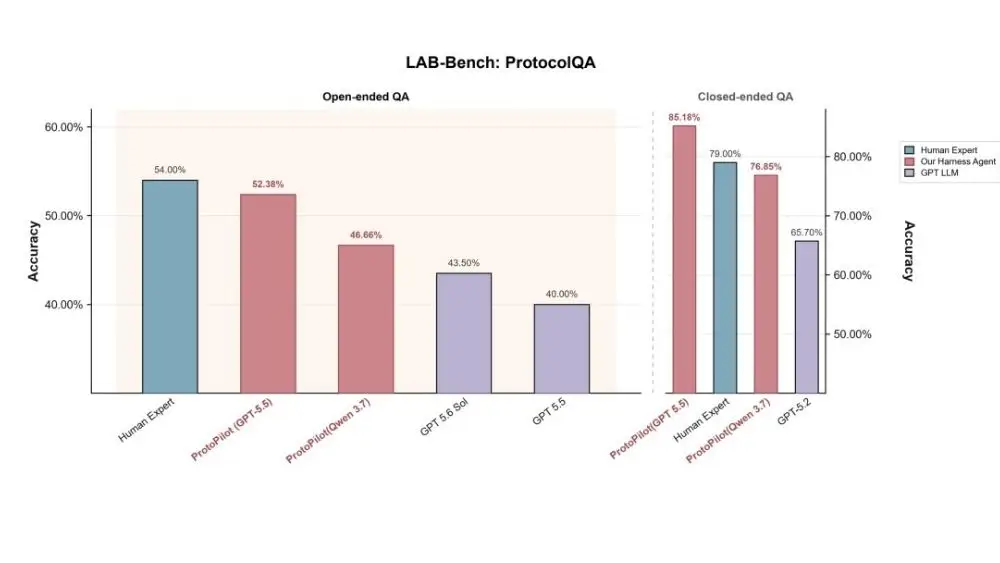
On the public ProtocolQA benchmark, ProtoPilot scored an impressive 52.38%. This result closely approaches the human expert level of 54%. Meanwhile, standard models like GPT-5.6-sol scored only 43.5%.
Setting a New Evaluation Standard
BioLab Bench establishes the first real-task evaluation framework for AI for Science. It measures whether an agent can execute tasks on real biotech automation systems.
The system features real-world task coverage across three distinct difficulty levels. Additionally, it provides a full-chain assessment from intent interpretation to execution verification. The framework also ensures cross-device transferability across varying hardware configurations.
Driving Toward Unattended Smart Laboratories
BioAgents will now improve through a continuous physical experimental loop. They will accumulate real research tasks, automation operations, and expert validations. Therefore, this data will soon power 24/7 unattended intelligent laboratories.
This initiative builds on MGI’s extensive hardware-native advantages. The company leverages deep integration across its automation platforms. Additionally, they utilize real-world deployment expertise from over 3,800 global users.
“It reflects a different path from the pure compute race. While leading AI companies rely on scale compute to push the capabilities of general-purpose models, we take a different approach. Through agent scaling and closed-loop data engineering, we organize real-world tasks, device constraints, expert feedback, and wet-lab results into a training ground where AI continuously evolves.” Noted Dr. Yang Meng, now serving as CEO in Genoria AI.
Explore Health Tech Insiders for the latest medical innovations and reliable strategic insights driving the future of technology-driven healthcare transformation.
News Source: PRNewswire.com