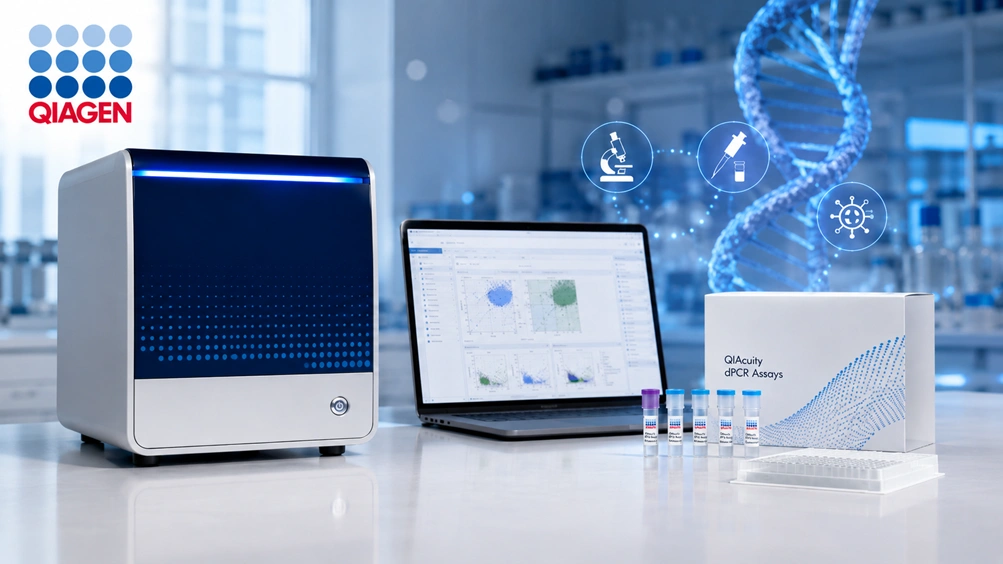
VENLO announced new additions to its Digital PCR technology by expanding its QIAcuity digital PCR platform. The company is focusing on enhancing gene expression capabilities, increasing assay content and strengthening workflow standardization for life sciences and biopharma applications.
Digital PCR adoption is being propelled by the need for increased sensitivity, accuracy, and multiplexing in research areas that have historically relied on qPCR technologies. QIAGEN is therefore expanding the QIAcuity ecosystem with new gene expression solutions, automated workflows and sophisticated analysis tools.
These advances are intended to drive the adoption of Digital PCR technology in molecular research, biotechnological and biopharmaceutical applications. The company is also continuing to support laboratories in achieving more reliable and scalable workflows with innovative molecular testing solutions.
“Gene expression represents one of the largest application areas in molecular biology and a significant opportunity for digital PCR,” said Thierry Bernard, CEO of QIAGEN. “By expanding the QIAcuity ecosystem with new assays, enhanced multiplexing capabilities and workflow solutions, we are helping customers apply digital PCR to a broader range of research and biopharma applications.”
New Gene Expression Solutions Strengthen Digital PCR Capabilities
Later in 2026, QIAGEN plans to grow its portfolio with new QIAcuity Gene Expression Assays. These solutions will help with gene expression analysis for human, mouse and rat research applications. The company also plans to release the QIAcuity OneStep High Multiplex Probe PCR Kit. The solution will allow researchers to analyze up to 12 RNA targets in one reaction.
This allows researchers to obtain more detailed biological insights with less sample consumption, less manual effort and less workflow complexity. In addition, these additions will augment QIAGEN’s GeneGlobe platform, which offers access to more than 10 million predesigned assays. Additionally, the platform provides custom assay design capabilities to support specialized molecular research needs. QIAGEN is further expanding its digital PCR solutions for Cell and Gene Therapy applications. The company is broadening its residual DNA testing portfolio to support a wider range of producer cell lines.
These systems include Sf9/Baculovirus, Pichia pastoris, Vero and Mouse applications. The portfolio also includes the newly launched QIAcuity HEK293 resDNA Sizing Kit. The kit enables accurate determination of host cell DNA concentration and size distribution. Thus, it benefits biopharmaceutical development and manufacturing processes that need accurate quality control. Later this month, QIAGEN will launch QIAcuity Software 3.5, which will feature improved analysis templates and automated reporting capabilities.
The software has been improved to allow the user to specify analysis and report parameters before the start of a run. This creates better consistency and less manual interpretation of data by laboratories. The software also automatically applies pre-defined analysis settings and generates reports after run completion. This means labs can improve traceability, operational efficiency and reporting accuracy. These capabilities are especially useful for larger scale and regulated laboratory environments.
Hamilton Integration, Increased laboratory automation
QIAGEN is also enhancing lab automation capabilities through its partnership with Hamilton. “The integrated robotic systems allow customers to automate their QIAcuity dPCR nanoplate setup and handling workflows. The process is automated including sample preparation, filling of the nanoplates and sealing procedures. That means high-throughput labs can increase productivity and reduce risks associated with manual handling. The integration also enables fully automated workflows from assay preparation to data analysis. This allows labs to establish a more uniform and scalable approach for digital PCR operations.
QIAcuity is increasingly being adopted by academic institutions, biopharmaceutical companies, and clinical research organizations. The platform has achieved more than 3,200 cumulative placements globally since its inception. We have more than 400 customers today running multiple QIAcuity instruments. The platform is described in more than 1,100 scientific publications. The growing QIAcuity ecosystem reflects QIAGEN’s commitment to supporting customers as they move from qPCR to dPCR technologies. Additionally, the company is advancing scalable, automated, and standardized digital PCR workflows for contemporary research and biopharma applications.
Explore Health Tech Insiders for the latest medical innovations and reliable strategic insights driving the future of technology-driven healthcare transformation.
News Source: Businesswire.com