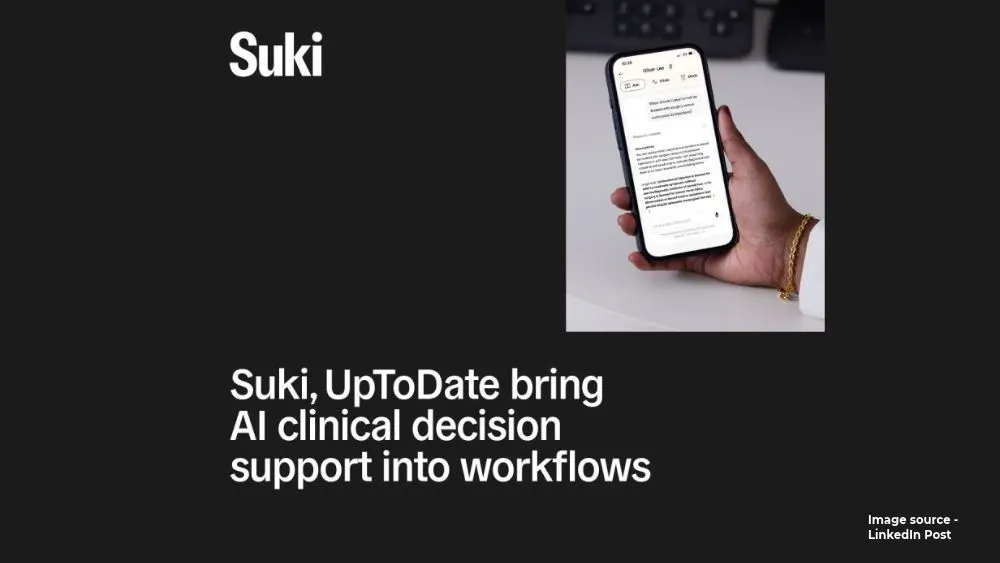
Suki launched Ask, a new clinical decision support capability powered by Wolters Kluwer UpToDate Expert AI. The integration delivers trusted medical knowledge and patient-specific information right into the clinician’s existing workflow. It allows healthcare workers to ask questions, either by speaking or typing, to get important patient information. Consequently, clinicians can view medications, allergies, vital signs, lab results and chronic conditions without having to manually search electronic health records (EHRs).
Suki, a leader in Ambient Clinical Intelligence (ACI), announced Ask’s availability across Epic, Oracle Health, athenahealth, and MEDITECH. The launch marks the first product integration of the UpToDate Expert AI API. Through this collaboration, both companies aim to simplify clinical information access and improve the delivery of evidence-based clinical decision support.
“Clinicians need trusted clinical intelligence from wherever they are in their clinical workflow,” said Yaw Fellin, Senior Vice President and General Manager, Clinical Decision Support and Provider Solutions, Wolters Kluwer Health. “Through this partnership, we’re extending the ability for them to easily access answers from UpToDate Expert AI directly from Ask in Suki for Clinicians without having to leave their workflow.”
Suki Ask Brings Evidence-Based Clinical Intelligence Into EHR Workflows
Unlike standalone clinical reasoning tools, Ask integrates clinical intelligence directly into the Suki for Clinicians app. The capability uses the Wolters Kluwer UpToDate Expert AI API to provide answers grounded exclusively in UpToDate’s proprietary clinical content. More than 7,600 physician authors, editors, and peer reviewers develop and maintain this medical knowledge.
Furthermore, clinicians with UpToDate access can ask complex medical questions and receive evidence-based responses. These answers include transparent sources supporting the underlying clinical evidence. They also provide medication and dosing considerations, alongside links to relevant medical content and drug monographs.
This allows clinicians to benefit from clinical decision support when evaluating patient-specific information. There’s no need to jump between separate applications again and again to find the guidance you need. This approach brings medical knowledge closer to the bedside.
The UpToDate Expert AI API allows healthcare technology partners to embed clinical intelligence into their existing digital platforms. This includes ambient documentation solutions, clinical agents, conversational assistants, and electronic health records.
The API delivers actionable clinical guidance into existing workflows from UpToDate’s trusted evidence-based content and editorial process. It also allows for flexible integration with UpToDate users, source-connected outputs and controls tailored for healthcare settings.
AI-Based Clinical Decision Support Fills Information Gaps
Health care providers often work with incomplete information to treat patients and document encounters. They also have to review medical histories, assess symptoms and make clinical decisions. However, it may take several searches to find a prior lab result or confirm a medication.
Likewise, the process of investigating a clinical question often entails bouncing around between different applications and sources of information. Such interruptions may contribute to the effort needed to carry out routine clinical tasks.
87 % of individual medical errors are related to extraneous cognitive load , says the American Medical Association . Research on task-switching also finds that shifting attention from one thing to another can hamper productivity.
In this context, Suki Ask presents a conversational approach to obtain clinical information. Rather than navigating through multiple screens manually, clinicians can ask questions directly and receive the information they need through a natural conversation.
For example, a clinician can ask Suki, “What was this patient’s last A1C?” Another question might be, “What medications is she currently taking?” Clinicians can also ask, “Does she have any documented allergies?”
Ask retrieves relevant patient-specific details from the available clinical context. Moreover, when a question requires broader medical knowledge, the system can provide evidence-based information powered by UpToDate Expert AI. Clinicians can access this guidance without leaving the Suki experience.
Together, these capabilities create a single conversational interface for patient information and trusted clinical knowledge. Therefore, healthcare professionals can move between patient-specific questions and broader medical inquiries within the same workflow.
Suki Expands Ambient Clinical Intelligence Beyond Documentation
Suki sees Ask as an important step in expanding Ambient Clinical Intelligence beyond clinical documentation. The company aims to help clinicians access information, support clinical reasoning, and manage other healthcare tasks through conversational AI.
“Ambient AI started by helping clinicians document the encounter, but its potential is much larger,” said Abhi Pathak, Chief Product Officer at Suki. “With Ask, clinicians can now interact with the information they need through natural conversation, whether that means understanding what has happened with a particular patient or accessing trusted clinical knowledge from UpToDate. We’re building toward a future where clinicians spend less time navigating technology and more time using information to care for patients.”
This approach connects clinical documentation with patient information and evidence-based medical knowledge. In addition, Suki plans to support assisted revenue cycle workflows and operational tasks through its broader Ambient Clinical Intelligence platform.
The company is bringing these capabilities together with patient context and intelligence from across the healthcare ecosystem. Consequently, Suki aims to create a more connected AI experience that supports clinicians throughout their daily responsibilities.
Ask shows how conversational artificial intelligence can help make clinical information more accessible. A simple question and healthcare providers can get the information they need without having to wade through complicated interfaces.
Early Evaluations Show Value of Patient Context
Early evaluations also indicated a preference for answers that contain patient-specific context. Clinician evaluators selected answers from UpToDate Expert AI that contained Suki-provided patient context 83% of the time. Responses without patient context were selected less frequently and this difference was statistically significant (p<0.001).
Moreover, this preference was observed across several categories of clinical questions. These covered clinical management, safety, diagnosis, screening and dosing. The main drivers for the preference were patient-context integration. These results highlight the possible benefits of integrating Ambient Clinical Intelligence with existing clinical reasoning capabilities.
Suki and Wolters Kluwer are collaborating to make clinical guidance more applicable to individual cases by incorporating relevant patient information within medical responses. Clinicians still make use of their professional judgment when evaluating information and making treatment decisions.
The results also emphasize the need for context-aware healthcare AI. The clinical information has more value if clinicians can interpret it according to documented history and the current situation of the patient.
Suki Ask Increases Access to Clinical Intelligence Across Healthcare Systems
The launch is a sign of Suki’s broader goal of tying clinical documentation, medical knowledge and workflow assistance to AI. The company is going beyond documentation to broaden its platform.
Ask lets clinicians access patient-specific information and trusted clinical knowledge via a conversational interface. The UpToDate Expert AI API also enables healthcare technology partners to embed source-grounded clinical intelligence into their products.
The collaboration combines Suki’s Ambient Clinical Intelligence capabilities with Wolters Kluwer’s evidence-based medical content. This means the integration provides a more direct way for healthcare professionals to get clinical decision support while they are caring for patients.
Suki Ask is now available on Epic, Oracle Health, athenahealth and MEDITECH. The launch represents another step in the adoption of conversational AI and evidence-based clinical intelligence across healthcare technology platforms.
Explore Health Tech Insiders for the latest medical innovations and reliable strategic insights driving the future of technology-driven healthcare transformation.
News Source: Businesswire.com