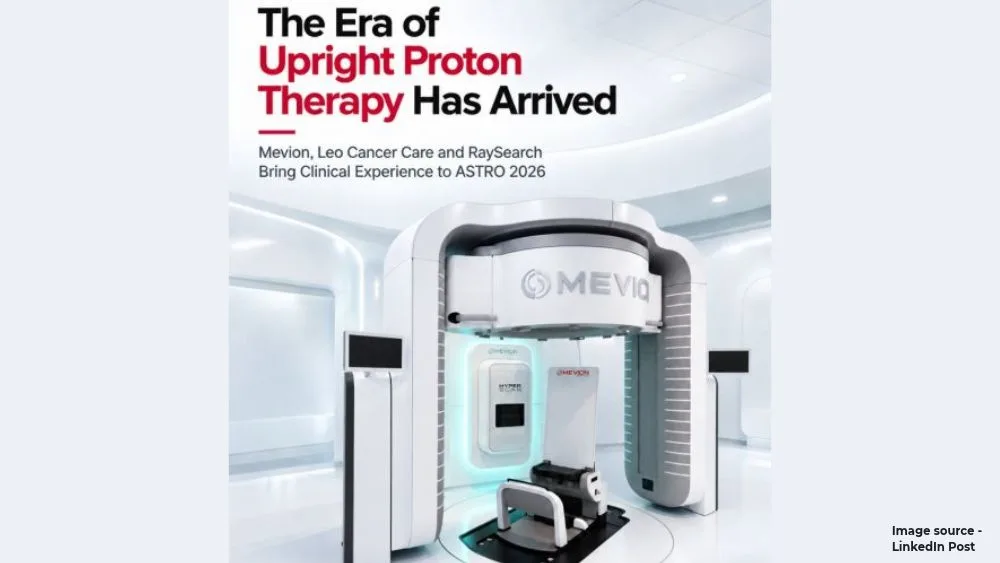
Upright proton therapy is gaining major attention at the American Society for Radiation Oncology 2026 Annual Meeting. Patients are now receiving treatment in the upright position. The milestone involves the MEVION S250-FIT Proton Therapy System™, Leo Cancer Care’s Marie® solution, and RayStation treatment planning.
Stanford Medicine treated its first patient upright on June 4, 2026. The treatment used a MEVION S250-FIT Proton Therapy System™. It also used Marie® upright positioning and imaging from Leo Cancer Care. RaySearch Laboratories provided the RayStation treatment planning platform. The integrated setup operates within a standard radiation therapy vault.
As a result, upright proton therapy enters ASTRO 2026 with direct clinical experience behind it. Mevion Medical Systems, Leo Cancer Care, and RaySearch Laboratories will showcase the technology. Attendees can experience the positioning system and speak with clinical specialists.
“Every health system should be able to offer proton therapy as part of its radiation oncology service,” said Tina Yu, PhD, President and CEO of Mevion Medical Systems. “With patients being treated in an existing department, the conversation can finally focus on how proton therapy fits into a health system’s clinical service, facilities and capital planning.”
Boston’s Historic Role in Proton Therapy
Boston holds a significant place in the development of proton therapy. In 1946, Harvard physicist Robert R. Wilson proposed using the Bragg peak for cancer treatment. His work helped establish the foundation for proton therapy. Fifteen years later, Harvard’s cyclotron and Massachusetts General Hospital began treating patients together. Their partnership continued for four decades. It also contributed to the early development of the field.
Mevion Medical Systems later strengthened Boston’s connection with proton therapy. The company launched in Massachusetts in 2004. Its mission focused on improving access to proton therapy for health systems. In 2012, the MEVION S250 Proton Therapy System® received FDA clearance. It became the world’s first compact proton therapy system. Then, in 2025, the MEVION FIT™ received FDA clearance.
The MEVION FIT™ became the first proton therapy system designed for an existing LINAC vault. Now, upright proton therapy adds another important development to that history.
Integrated Proton Therapy Expands Treatment Options
Radiation oncology departments continue to adopt advanced treatment technologies. These technologies include IGRT, IMRT, and VMAT. Integrated proton therapy adds another treatment option to this existing environment. The approach allows teams to deliver proton therapy within their current radiation oncology service. It also uses existing clinical teams and infrastructure. Therefore, health systems can consider proton therapy without building a separate treatment environment.
The FIT™ system supports installation inside a standard radiation therapy vault. This design can help community programs evaluate proton therapy. It can also support academic centers facing limited expansion space. Currently, around a dozen FIT™ systems are in development worldwide. The approach gives health systems another pathway toward integrating proton therapy.
FIT combines several technologies into one compact proton therapy platform. Mevion provides its ultra-compact proton accelerator and HYPERSCAN® pencil beam scanning technology. Leo Cancer Care contributes the Marie® 360-degree upright positioning system.
The platform also includes integrated CT imaging. RaySearch Laboratories powers treatment planning through its RayStation® system. Together, these technologies support proton therapy within a compact radiation oncology environment. The system also features Mevion’s Adaptive Aperture for patient-specific beam shaping. At ASTRO 2026, teams can also discuss future technologies. These include DirectARC™ proton arc therapy and adaptive workflows.
Upright Positioning Supports Clinical Practice
Leo Cancer Care has focused on upright patient positioning and imaging. Its systems support clinical and research applications internationally. The company has also developed research around upright treatment. Its published work covers positioning reproducibility and imaging in treatment posture. It also examines the patient experience during treatment.
“Our work is to help clinical teams bring upright imaging and positioning into daily practice,” said Stephen Towe, CEO of Leo Cancer Care. “At ASTRO, we want therapists, physicists and physicians to experience the setup and discuss the practical questions that matter in their departments.”
RaySearch Laboratories continues to develop treatment planning solutions for particle therapy. RayStation is used at the majority of particle therapy centers worldwide.
For upright treatment, RaySearch extended its dose calculation capabilities. The company also adapted plan optimization for upright treatment geometry. RayStation now supports clinical upright proton therapy at Stanford Medicine.
“We are proud to have contributed to the first proton treatments at Stanford Medicine together with Mevion and Leo Cancer Care,” said Johan Löf, Founder and CEO of RaySearch Laboratories. “Through the close integration of the three systems, we have shown that RaySearch’s advanced and well-established proton therapy algorithms deliver high performance also when treating patients in the upright position.”
Clinical Experience Comes to ASTRO 2026
ASTRO 2026 will feature clinical research based on Stanford Medicine’s experience. The scientific program includes three Stanford-led posters. These presentations address several areas of upright therapy. The topics include clinical integration and pediatric upright treatment. They also cover anesthesia integration and proton delivery workflows.
The program begins on Friday, September 25, with The Upright RT Summit. Leo Cancer Care will host the user meeting for adopting institutions. The event focuses on upright radiation therapy across multiple treatment modalities. The half-day summit will examine current clinical experience and future developments. It will also cover research, immobilization, and pediatric applications. In addition, participants will discuss technology and integration plans.
On Saturday, September 26, the Dana-Farber Proton Therapy Symposium will address multidisciplinary cancer care. The session will explore upright proton therapy integration within cancer treatment programs. Later that day, Mevion will host the “Inside Proton Innovation” experience. The event will take place at Mevion’s Littleton, Massachusetts headquarters. Discussions will cover treatment planning, adaptive workflows, upright positioning, and manufacturing.
The conversation will continue across the ASTRO exhibition floor. Attendees can visit Mevion at booth #2117. Leo Cancer Care will be at booth #519. RaySearch will be at Booth #724. At the Mevion and Leo Cancer Care booths, attendees can experience upright positioning. They can also sit in the system and explore the setup. At the RaySearch booth, visitors can see MEVION FIT treatment plans created in RayStation.
Mevion will also host a Meet the Experts program. The sessions will run from Sunday through Tuesday. Physicians, physicists, and therapists will discuss clinical practice and departmental integration.
Proton Therapy Moves Toward Wider Clinical Access
The momentum around upright proton therapy now extends beyond ASTRO 2026. Patients are receiving treatment with the technology in clinical settings. Clinical teams are also sharing their experience with the approach. Meanwhile, health systems have a practical example of integrated proton therapy. The example demonstrates how proton therapy can fit within an existing department.
Mevion, Leo Cancer Care, and RaySearch continue to focus on providing the best solutions to understand and address the access problem. Thanks to their synergistic approach, these three provider institutions can offer solutions for positioning, imaging, treatment planning, and proton delivery. While the use of upright proton treatment is still being established, the ASTRO 2026 convention speaks about the developments in this field.
Explore Health Tech Insiders for the latest medical innovations and reliable strategic insights driving the future of technology-driven healthcare transformation.
News Source: Businesswire.com