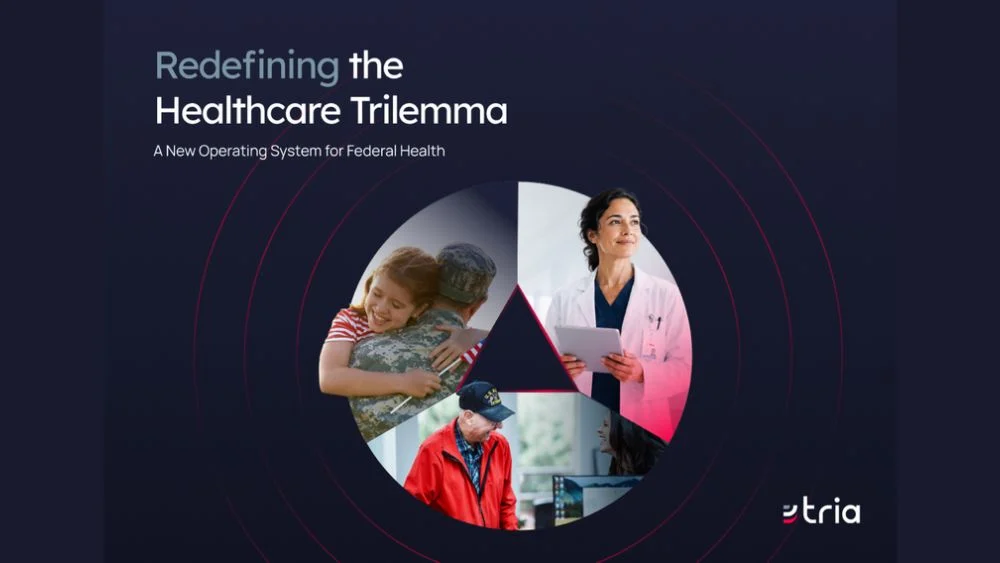
Tria Federal today launched a new thought leadership campaign focused on the healthcare trilemma. The campaign gives federal health leaders a shared framework for managing cost, quality, and access. The initiative includes a new microsite and a free e-book for federal health professionals. The microsite is available at https://triafed.com/the-healthcare-trilemma.
The campaign also introduces the e-book, “Redefining the Healthcare Trilemma: A New Operating System for Federal Health.”
Tria Federal developed the campaign to address complex challenges across federal healthcare programs. These challenges often involve difficult decisions between cost, quality, and access. However, the company presents another approach to these competing priorities. Well-designed interventions can help move all three areas forward.
The approach depends on system-wide visibility and coordinated healthcare operations. It also focuses on understanding how decisions affect connected parts of the healthcare system. At the scale of federal health agencies, small improvements can create significant financial effects. A one-percent improvement in one area can represent billions of dollars.
The e-book describes these results as “compounded gains.” These gains can support agencies such as the Centers for Medicare & Medicaid Services (CMS), the Department of Veterans Affairs (VA), and the Defense Health Agency (DHA).
“CMS, VA, and DHA each contend with a version of the healthcare trilemma while carrying out their missions for millions of Americans,” said Tria CEO Tim Borchert. “They manage it every day, often without a shared language for it. This campaign is about contributing to that language – a model that helps federal leaders see how decisions in one corner of the trilemma ripple through the others, and what it looks like to systematically close the gap between what’s promised and what’s delivered.”
The Healthcare Trilemma and Federal Health
The healthcare trilemma represents a practical challenge for federal health programs. It affects decisions involving healthcare affordability, availability, and quality. Moreover, these challenges occur across programs serving millions of Americans. Federal health programs now represent more than 30 percent of the total FY2026 federal budget.
This share exceeds the combined portions represented by Social Security and defense. Consequently, decisions across federal healthcare can create broad effects. Behind these figures are people who depend on federal health services. For example, a Medicaid beneficiary may face a 30-day re-verification deadline.
Similarly, a Veteran may need to determine how far to travel for an appointment. A servicemember may also wait for referral authorization before the next rotation. Therefore, healthcare decisions can directly influence people’s daily experiences. The healthcare trilemma connects these individual experiences with larger operational decisions.
A New Federal Healthcare Operating System
Tria Federal’s new e-book introduces seven components of a federal health operating system. These components include beneficiary, policy, resources, workflow, measurement, accountability, and outcome. The framework presents these elements as parts of one connected system. As a result, federal agencies can examine decisions across multiple operational areas.
The e-book also explores ways agencies can manage the healthcare trilemma. It focuses on avoiding improvements in one area that create problems elsewhere.
“We’re launching this campaign because federal health leaders deserve a shared model—not just better tools,” said Diana Ceban, Tria’s Chief Growth Officer. “The trilemma requires constant tradeoffs, and those tradeoffs have names and faces. We’ve seen it from the inside across our customers for two decades. Today, we continue contributing to that conversation in a way that’s useful, starting with hard questions, not easy answers.”
In addition, the e-book examines the role of artificial intelligence in federal healthcare. AI can accelerate certain improvements across healthcare operations. However, technology alone cannot address every operational challenge. Successful AI implementation requires strong governance and informed decision-making.
It also requires people who understand the underlying healthcare system. Therefore, organizations must combine technology with effective healthcare management practices.
Building an Ongoing Federal Health Resource
The new microsite will continue serving as a resource library for federal health leaders. Tria Federal plans to add new content to expand the campaign’s central discussion. Upcoming articles will examine how the healthcare trilemma differs across federal agencies. They will also explore operational decisions that influence healthcare outcomes.
These areas include eligibility, network adequacy, payment integrity and care coordination. Each area can affect beneficiary costs, quality and access. Tria Federal’s campaign hopes to continue the conversation about how federal healthcare works. The company is marketing the framework as a tool for leaders working on complex healthcare priorities.
At the end of the day, this campaign is about creating a connected view of federal health systems. It emphasizes how operational decisions impact a variety of healthcare outcomes. The initiative also invites federal health leaders to grapple with tough tradeoffs within a common framework. This sort of approach can foster better conversations about health care delivery, access, quality and cost.
Explore Health Tech Insiders for the latest medical innovations and reliable strategic insights driving the future of technology-driven healthcare transformation.
News Source: GlobeNewswire.com