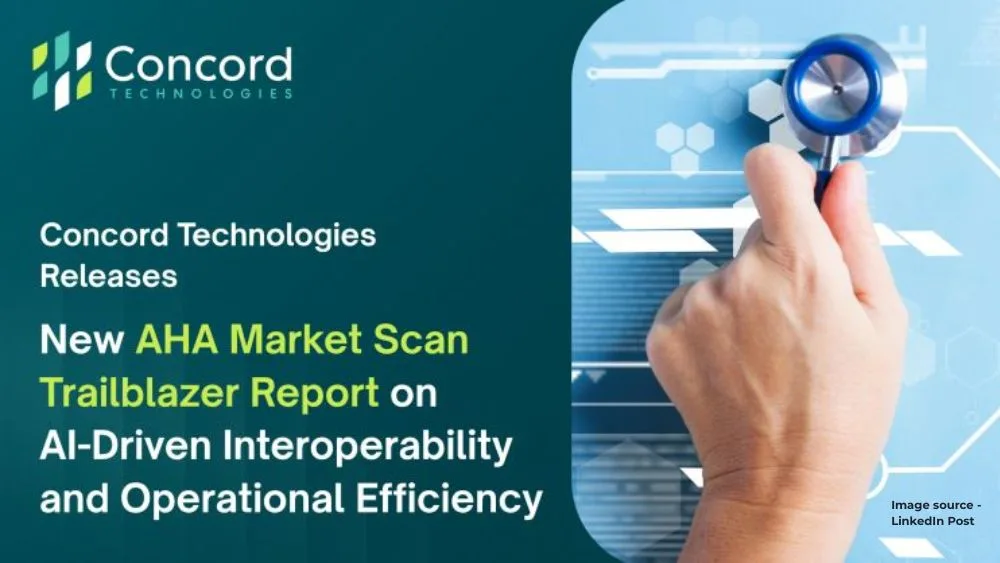
Concord Technologies officially unveils a landmark study focusing on healthcare interoperability today. This fresh report examines how artificial intelligence transforms modern medical networks. Plus, the technology simplifies patient workflows and cuts down on administrative tasks significantly. This important research was produced by the organization in collaboration with the American Hospital Association. The publication’s formal title is “Applying AI to Achieve Interoperability and a Smarter Patient Workflow.” This means industry leaders get deep insights into how to improve operational efficiencies.
Modern medical groups are now facing severe administrative bottlenecks every day. But artificial intelligence has automated tools, such as intelligent document processing, to handle data. “Data from the 2026 industry survey reveal very promising healthcare interoperability solutions. In particular, 64% of hospital executives say AI accelerates ecosystem connectivity. That’s a big shift in the way providers approach modern information exchange.
Simplify patient workflow and operations
AI technologies enable medical networks to quickly identify complex patterns. Moreover, these smart tools put context to the incoming data from the different messages. Staff members can extract relevant facts without manual entry errors. Therefore, clinicians spend less time typing and more time with individuals. This approach radically improves overall healthcare delivery speeds.
“Healthcare organizations are under enormous pressure to improve operational efficiency while also delivering a better patient experience,” said Julie Freguia, Chief Marketing Officer at Concord. “What we’re seeing now is a shift from viewing AI as experimental technology to recognizing it as a practical tool for solving real interoperability and workflow challenges. This report highlights how healthcare leaders are beginning to apply AI in meaningful ways that reduce friction, accelerate information flow, and free staff to focus more directly on patient care.”
The newly released report also highlights a real-world case study. WakeMed, a nonprofit health system in North Carolina, deployed the advanced Concord Connect platform. Consequently, this deployment utilizes the firm’s Practical AI approach to upgrade contact center operations. The system is expected to save huge amounts of time when processing millions of incoming faxes. Consequently, team members focus their efforts on providing direct support to patients.
“These valuable findings are a natural extension of these important industry panels held at HIMSS 2026.” Earlier this year, the American Hospital Association helped with those important conversations. The expert panel conducted a holistic assessment of the large language models within existing data exchange ecosystems. They spent a lot of their time fixing legacy software limitations. Ultimately, the new report demonstrates how automation successfully scales healthcare interoperability.
Moving forward, Concord Technologies aims to deepen these clinical integrations and continuous learning loops across its digital health network. By focusing heavily on bridging the gaps left by traditional, legacy infrastructure, Concord Technologies plans to expand its practical AI toolset to eliminate even more manual data barriers for providers nationwide. This ongoing growth ensures that medical networks can confidently navigate future regulatory shifts while maintaining an uninterrupted focus on patient-centered care.
Explore Health Tech Insiders for the latest medical innovations and reliable strategic insights driving the future of technology-driven healthcare transformation.
News Source: Businesswire.com