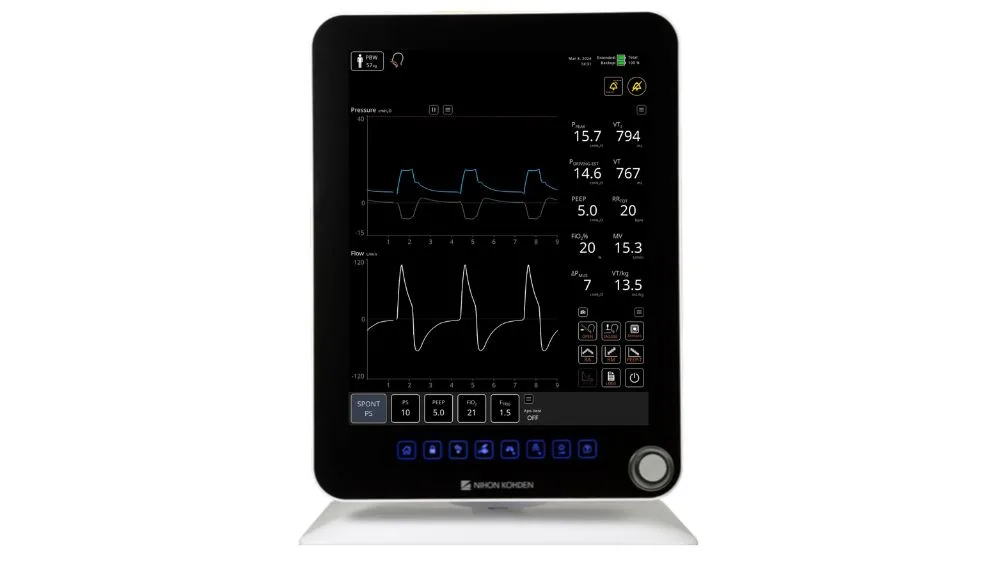
Nihon Kohden America has upgraded the NKV-550 ventilator with three advanced capabilities designed to improve respiratory care. The enhancements provide clinicians with better visibility into patient breathing effort at the bedside.
The new NKV-550 ventilator includes Non-invasive Muscle Pressure (Pmus) measurement, Adaptive Ventilation Mode (AVM), and customizable AdaptiveSync™. These functionalities aid in controlling ventilator-induced lung injury (VILI) and self-induced lung injury (P-SILI) in patients. The Non-invasive Pmus measurement gives clinicians the capacity to have real-time information about the effort put in by the patient during breathing. Moreover, there is no need for invasive methods in this case.
AVM automatically evaluates patient lung mechanics and adjusts ventilator settings accordingly. As a result, clinicians can reduce manual adjustments during different ventilation stages. The technology supports patients from full ventilation through the weaning process. The NKV-550 ventilator addresses a major challenge in respiratory care. Clinicians often struggle to identify when patients are working too hard to breathe. Traditional observation methods may not always provide accurate information.
“There’s no objective, non-invasive and continuous monitoring readily available at the bedside to tell you how hard a patient is working to breathe, so every clinician is making their own judgment call,” said Hong-Lin Du, MD, PhD, President & CEO, Nihon Kohden OrangeMed, LLC. “One looks at neck muscles. Another watches the chest rise. If the patient is obese, weak or has a stiff chest wall, those visual cues may not even be there. And the ventilator numbers can look completely normal while the patient is quietly overworking their respiratory muscles.”
NKV-550 Combines Adaptive Ventilation and Patient Monitoring
Additionally, the NKV-550 calculates Pmus with each breath cycle. It does not use any extra equipment for calculating Pmus; it makes use of the available measurements of the ventilator. The live data is readily available to the medical professionals in the form of waveforms and numeric values on the display. There is also a feature called AdaptiveSync™ Technology that the NKV-550 offers.
Additionally, AVM also controls parameters such as breathing rate, tidal volume, and pressure support. Moreover, mechanical power is also observed through the system to ensure the minimization of the risk of causing any damage to the lungs. Through the integration of effort monitoring, adaptive ventilation, and synchronization technologies, the NKV-550 is able to offer a total respiratory management system.
Explore Health Tech Insiders for the latest medical innovations and reliable strategic insights driving the future of technology-driven healthcare transformation.
News Source: Businesswire.com